
Using The Collaboration Model


Using The Collaboration Model: Why Does It Matter?
How’s collaboration working for you? * Are you delegating directions to work with each other? Are you achieving shared goals? * Or, are you delegating without receiving 100% of the expected results? * Do you find yourself picking up the jobs you delegated and doing them yourself? * Learning Alliances not only trains our clients on the use of the Collaboration Model but we use it internally so that we can achieve the best possible results.
According to Wikepedia, “Collaboration is working with each other to do a task and to achieve shared goals…Structured methods of collaboration encourage introspection of behavior and communication.”
Let me explain the model of collaboration that we use and teach Learning Alliances. * GRR!!! * Have you ever been assigned to a team that has at least one team member you don’t trust to get the job done? * Most of us groan and say, “It would be easier to do the job myself!” * Sometimes we even growl with a grr. * Our GRR stands for Goals, Roles and Rules and it is a practical tool that enhances communication for clarity, identification of tasks and results, and what parameters you must apply for success.
Think of the model as a target.* 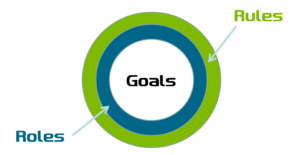
First think of the bulls eye… * G represents Goals and they can also be known as the what. * In America and many other countries, we are so busy doing and don’t take time to think about the end result we are directing. So, with the goal, think first of what is to be* achieved also known as the* outcome or result.
- Caution! Do not start with the actions to be taken. * Start with the end result that’s to be achieved.
- Be specific and clear so that all can clearly understand.
Secondly, the next ring around the bulls eye represents the R element known as Roles. * Who is doing what? Who has the authority for decisions? Who will document? Who has the money? This covers all the WHO’s.
- Anytime a new person is added to the team, even temporarily, bring the team together and communicate everyone’s roles so the new team member and everyone else is familiar and aware of each other’s roles.
- This decreases tasks that need to be completed but no one does.
- This also decreases redundancy when two different people think it’s their job to do…
Thirdly, the outer ring of the target is another R which represents Rules. * Rules are the* how to get things done. * How do you demonstrate acceptable behaviors? How do you demonstrate unacceptable behaviors? How are you trained on new or different technical tools required for the task? How do you know what technical tools are required? How do you communicate updates? * Anything that has to do with the parameters of the work is the Rules for how to accomplish the goal.
A few important tips:
- Use the GRR Collaboration Model when the end results are important to you and the organization.
- Tie the goals to the organization’s strategies and goals.
- Anytime a conversation or meeting gets off target, ask, “How does this connect to our stated goal?” If it does not, put that subject on a follow-up or later action notes, and get back to the right topic for focus.
- Know that this will not save you time because you have think about your conversation in advance.
- This will change what you talk about. * Examples:
- Instead of fixing more problems, you spend time up front to clearly and commonly communicate for a more accurate and timely result.
- In meetings, this process will assist in getting the group back on focus.
There is much more to this GRR Collaboration Model. * If we have tweaked your interest, please contact us!